

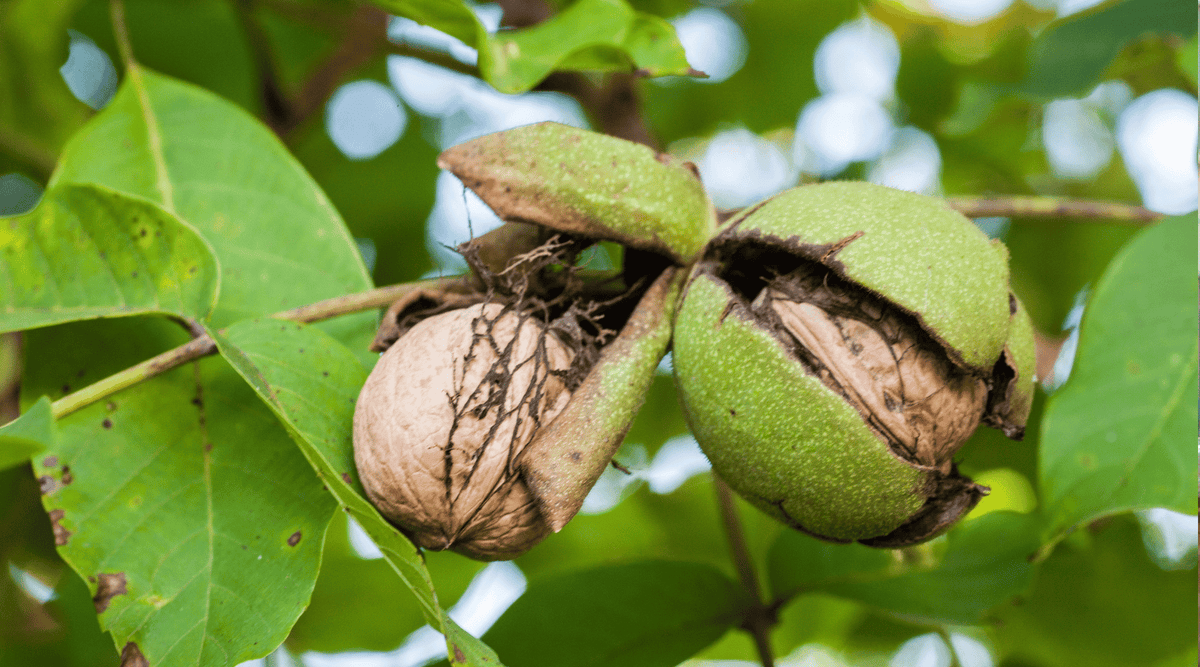
Long before black walnut hulls appeared in herbal formulas, the Chickasaw had discovered something remarkable about this native tree.
They bruised the green hulls of black walnuts and submerged them in the water, where the natural compounds released from the hulls could stun fish and make them easier to collect.
It sounds almost like folklore, but it isn’t.
Modern science has identified a potent natural compound in black walnut called juglone, and laboratory research confirms that juglone can have powerful effects on fish. It's also one reason black walnut has earned a reputation among gardeners: certain plants simply don't fare well when they're growing too close to the tree.
But here's where the story gets even more interesting.
For generations, black walnut has also had a place in traditional herbal medicine. And today, the green hull is probably best known for something entirely different: its use in herbal parasite-cleansing formulas.
So what is it about this unassuming green hull that made it useful centuries ago and keeps herbalists interested in it today?
What Are the Benefits of Black Walnut Hull?
Black walnut (Juglans nigra) is native to eastern North America, and nearly every part of the tree has been put to use at one time or another. The nuts provided food, the wood became prized for woodworking, and the hulls and bark supplied natural dyes. Indigenous peoples also used different parts of the tree in traditional remedies.
The green outer hull is particularly interesting because it contains a collection of naturally occurring plant compounds, including juglone, tannins, and other polyphenols.
Juglone gets most of the attention because of its biological activity. Research has found antimicrobial, antifungal, and antiparasitic activity associated with juglone, although much of this evidence comes from laboratory and preclinical research rather than human clinical trials.
And that's an important distinction.
Black walnut has a long history of traditional use, but we don't yet have large human trials showing that taking black walnut hull supplements will eliminate intestinal parasites. What we do have is an intriguing combination of traditional use and laboratory evidence that helps explain why this plant has remained part of herbal parasite protocols for so long.
Why Is Black Walnut Hull Used for Parasites?
For generations, herbalists have used black walnut hull to help clear unwanted organisms from the intestinal tract. And modern research gives us some clues as to why.
One of the most interesting involves nematodes, the large family of roundworms that includes many parasitic species. In laboratory research, a black walnut husk extract was shown to repel plant-parasitic nematodes and reduce their ability to penetrate plant roots.
Researchers have also investigated the antimicrobial and antifungal activity of compounds found in walnut hulls, adding to the evidence that this plant contains some remarkably active natural chemistry.
Why Black Walnut Is Often Paired With Other Herbs
There's a reason traditional herbal formulas rarely rely on just one plant.
Black walnut may be the star of this story, but when it comes to intestinal cleansing, it has traditionally been paired with other bitter and cleansing herbs. That's the thinking behind Verma-Plus, UNI KEY's liquid herbal formula.
Black walnut hull is joined by wormwood, cloves, centaury, male fern root, orange peel, and butternut root bark, creating a broader herbal approach to supporting the body's natural elimination of unwanted organisms.
But Verma-Plus is only one piece of UNI KEY's complete parasite protocol.
A More Complete Approach to Parasite Cleansing
UNI KEY's 30-Day Parasite Cleanse combines three formulas that play different roles:
- Para-Key provides additional herbs and plant extracts to support intestinal cleansing.
- Verma-Plus supplies black walnut and its companion herbs.
- Flora-Key comes in during the final phase to replenish beneficial bacteria and help restore balance to the gut after cleansing.
It's a simple idea: cleanse, clear, then rebuild.
And that may be the bigger lesson behind black walnut hull. One herb can be fascinating. But when you're supporting something as complex as the intestinal environment, the whole protocol matters.
If you’ve ever wondered whether parasites could be behind some of your symptoms, this guide explains the signs to watch for.

30-Day Parasite Cleanse
- ✓ Provides herbs and plant extracts to support intestinal cleansing.
- ✓ Supplies black walnut and its companion herbs.
- ✓ Replenishes beneficial bacteria and helps restore balance to the gut after cleansing.
The Bottom Line
Centuries ago, people didn't know the word juglone. They simply knew there was something remarkably powerful hiding inside the green hull of the black walnut.
Today, science is beginning to help us understand why.
Black walnut still has plenty of secrets left to reveal, but its long history of use and fascinating natural chemistry explain why this humble hull continues to earn a place in traditional parasite-cleansing formulas.
Learn More:
- Parasite Cleanse: What It Is, Signs to Watch For, and How to Do It Safely
- Parasite Cleanse Diet: What to Eat (and Avoid)
- Parasites in Food: How They Get In and How to Protect Yourself
Frequently Asked Questions
What are the main black walnut hull benefits?
Black walnut hull has a long history of traditional use for intestinal cleansing and unwanted organisms. Its hull contains naturally occurring compounds including juglone, tannins, and polyphenols that have demonstrated antimicrobial, antifungal, and other biological activity in laboratory research.
Does black walnut hull kill parasites?
Black walnut hull has traditionally been used in parasite-cleansing preparations, and laboratory research involving some of its compounds is intriguing.
What is the active ingredient in black walnut hull?
Juglone is one of black walnut's best-known compounds and has been studied for a variety of biological effects. But black walnut hull isn't a single-compound herb. It also contains tannins, polyphenols, and other naturally occurring plant compounds.
What herbs are commonly combined with black walnut hull?
Black walnut is often paired with other traditional cleansing herbs. UNI KEY's Verma-Plus, for example, combines black walnut hull with wormwood, cloves, centaury, male fern root, orange peel, and butternut root bark.
Resources include:
Maleita C, Esteves I, Braga MEM, Figueiredo J, Gaspar MC, Abrantes I, de Sousa HC. Juglone and 1,4-Naphthoquinone-Promising Nematicides for Sustainable Control of the Root Knot Nematode Meloidogyne luci. Front Plant Sci. 2022 May 17;13:867803. doi: 10.3389/fpls.2022.867803. PMID: 35656011; PMCID: PMC9152545.
Washington College, Center for Environment & Society. “Black Walnut (Juglans nigra)”
Clark AM, Jurgens TM, Hufford CD. “Antimicrobial Activity of Juglone.” Phytotherapy Research. 1990;4(1):11–14.
Amarowicz R, Dykes GA, Pegg RB. “Antibacterial activity of tannin constituents from Phaseolus vulgaris, Fagopyrum esculentum, Corylus avellana and Juglans nigra.” Fitoterapia. 2008;79(3):217–219.
Moreira CS, et al. “Juglone: A Versatile Natural Platform for Obtaining New Bioactive Compounds.” Current Medicinal Chemistry. 2021;28(22):2018–2045.
Southern Cross University. “Juglans nigra.” Medicinal Plant Monograph.


